

Commercial interior projects rarely fail because of bad decisions. They fail because the wrong service model is chosen at the start.
Most businesses say they need commercial interior design services, but they don’t clearly define what they expect from the team they hire. Some expect drawings. Some expect site execution. Some expect one team to take responsibility until the space is ready for daily use.
When expectations and services do not match, problems appear early.
- Drawings are completed, but no one owns execution decisions.
- Execution begins, but the drawings lack clarity for the site conditions.
- Costs increase because the scope was assumed rather than defined.
- Timelines stretch because responsibilities overlap or stay unclear.
Commercial interior services are not interchangeable. Each model carries a different level of control, involvement, and risk.
Understanding this difference is what separates stable projects from stressful ones.
Why service selection matters more than design style
Design style can change during a project.
Service structure cannot be provided without cost and delay.
Once work begins, the service model decides:
- Who makes decisions on site
- Who controls changes
- Who absorbs risk
- Who manages coordination
When the wrong service model is selected, teams end up fixing problems instead of building spaces.
This is especially true for office interiors, where systems, timelines, and daily use pressure expose gaps quickly.
How commercial interior services are commonly misunderstood
Many clients assume commercial interior services fall into only two categories:
- Design
- Execution
In reality, commercial interior work operates across four distinct service models, each suited to different project conditions.
These models are:
- Commercial interior design (design-only)
- Design with execution support
- Commercial interior fit-out services
- Turnkey commercial interior solutions
Each model exists for a reason.
Each serves a specific project need.
Problems arise when one model is expected to perform like another.
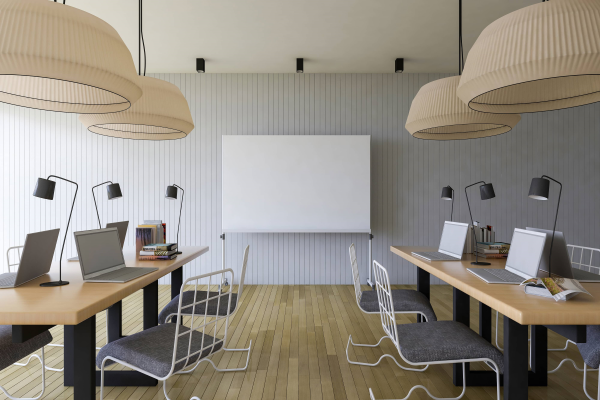


Service Model 1: Commercial Interior Design (Design-Only Services)
Design-only services focus on planning, layout, and documentation. They do not include building the space.
What design-only commercial interior services include
Typically, this service covers:
- Requirement discussions and space analysis
- Area zoning and circulation planning
- Layout development and final layout drawings
- Concept direction aligned with the brand or business use.
- Material and finish selection guidance
- Lighting intent planning
- Furniture and workstation layouts
- Detailed working drawings for execution
The output is a design package, not a completed interior.
What design-only services do not include
Design-only services usually exclude:
- Contractor coordination
- Daily site supervision
- Material procurement
- Execution scheduling
- Quality control during construction
Once drawings are handed over, responsibility shifts to the execution team and the client.
Where design-only services work well
This model works best when:
- The client already has a strong execution team
- The project scope is simple and well-defined.
- Minimal system changes are required.
- The client wants direct control over vendors.
In such cases, design-only services provide flexibility and clarity.
Where design-only services break down, especially in offices
Office interiors rarely remain simple once work starts.
They involve:
- High seating density
- Electrical and data coordination
- Meeting rooms with technical needs
- Access control and security planning
- Acoustic control
In office projects, design-only services often struggle because:
- Execution teams interpret drawings differently
- Site conditions force changes not accounted for in design.
- System coordination issues appear late.
- Designers are not present to resolve execution conflicts.
This is a common reason office interior costs rise after work begins.
Service Model 2: Commercial Interior Design with Execution Support
This model exists to reduce gaps seen in design-only projects.
What design with execution support includes
Along with design, this service usually provides:
- Clarification of drawings during execution
- Periodic site visits
- Support in resolving design-related site questions
- Guidance during material finalisation
- Review of execution against design intent
The designer stays involved but does not control the site daily.
What execution support does not include
Typically excluded:
- Daily site supervision
- Contractor billing control
- Procurement responsibility
- Execution scheduling ownership
The client or a separate project manager coordinates the site.
When this model works well
This model suits projects where:
- The client manages contractors directly
- The project has moderate complexity.
- Design continuity is important.
- The client wants a design presence without full responsibility transfer.
It reduces misinterpretation but does not remove coordination load.
Common failure points in this model
Issues appear when:
- Designers are expected to solve execution issues without authority
- Contractors seek decisions beyond design scope.
- Changes are made without cost or timeline tracking.
Clear boundaries are essential for this model to work.
Why office interior projects expose service mismatch fastest
Office interiors highlight service issues sooner than most commercial spaces.
This is because offices combine:
- Dense services
- Continuous daily use
- Tight move-in timelines
- Staff productivity dependency
A poorly planned workstation layout, a missed power point, or acoustic issues affect operations immediately.
In office interiors:
- Design-only services often lack execution alignment
- Execution-only services suffer from incomplete drawings.
- Mixed responsibility leads to delays and rewor.k
This is why many office projects shift toward fit-out or turnkey models midway, often at a higher cost.
How Trimit Rachana approaches service clarity
Trimit Rachana approaches commercial interior services by clearly defining responsibilities at every stage.
Rather than treating services as interchangeable, the focus remains on:
- Matching service type to project complexity
- Aligning design depth with execution requirements
- Reducing handover gaps between teams
This approach supports stable timelines and controlled execution across office, retail, hospitality, healthcare, and mixed-use interiors.
That model is a turnkey commercial interior solution.
But turnkey is not a shortcut. It is a responsibility-heavy structure. When chosen without clarity, it can create new problems rather than solve old ones.
This section explains how turnkey services actually work, when they make sense, and how they differ from fit-out services in real project conditions, especially for office interiors.
Service Model 4: Turnkey Commercial Interior Solutions
Turnkey services mean one team takes responsibility from planning to final handover.
The client receives a space that is ready for use, not a set of drawings or partially completed work.
What turnkey commercial interior services include
Turnkey services typically cover:
- Requirement understanding and space analysis
- Layout planning and design development
- Detailed drawings coordinated across all systems
- Material and finish finalisation
- Vendor and contractor coordination
- Procurement management
- Site execution and supervision
- Quality control across all stages
- Timeline management
- Final testing and handover
The key difference is ownership.
The same team carries responsibility from start to finish.
What turnkey services change for the client
In a turnkey model:
- The client does not manage multiple vendors
- Decisions are routed through a single team.
- Changes are tracked for cost and time impact.
- Accountability is clear
This structure reduces confusion but increases the service provider’s responsibility.
Why turnkey services suit office interiors particularly well
Office interiors combine design, systems, and daily use pressure.
They involve:
- Workstation planning
- Electrical and data layouts
- Meeting rooms with technical needs
- Access control
- Fire safety coordination
- Acoustic control
- Tight move-in timelines
In non-turnkey models, these elements are often split across teams.
In turnkey projects:
- Design decisions account for execution limits
- System coordination happens before work starts.
- Conflicts are resolved internally, not on-site.
- Changes are evaluated for cost and time immediately.
This is why turnkey is often chosen for mid- to large-scale office projects.
Turnkey vs Fit-Out: The decision most clients struggle with
Many clients confuse fit-out services with turnkey services.
They are not the same.
Fit-out services focus on execution.
Fit-out teams:
- Build based on approved drawings
- Follow the defined scope
- Expect decisions to be final before work starts.
Fit-out services work well when:
- Designs are fully resolved
- Drawings are detailed
- Minimal changes are expected.
Problems arise when:
- Design gaps appear during execution
- Site conditions force changes
- Decisions are delayed
Fit-out teams cannot redesign on the fly without affecting the project.
Turnkey services integrate design and execution.
Turnkey teams:
- Control both drawings and site work
- Adjust design within defined limits.
- Track the impact of changes immediately
This reduces rework and delay.
When fit-out makes sense over turnkey
Fit-out may be the right choice when:
- The design is complete and coordinated
- The client wants execution-only support
. - The scope is stable
- Budget flexibility is lo.w
Fit-out reduces service cost but increases coordination responsibility.
When turnkey is the safer option
Turnkey is often safer when:
- The project is complex
- The timeline is tight.
- The client wants a single point of responsibility.
- Office operations depend on the timely completion.
The cost may appear higher initially, but risk control is stronger.
Cost control in commercial interior services
Cost overruns rarely come from pricing alone.
They come from a service mismatch.
How design-only services affect cost
Costs increase when:
- Drawings lack execution clarity
- Changes occur during construction.
- Responsibility for revisions is unclear.
Each revision adds time and expense.
How fit-out services affect cost
Costs increase when:
- Design assumptions fail on site
- Materials are not finalised early.
- Decisions are delayed
Fit-out teams charge for changes because they fall outside the scope.
How turnkey services manage cost differently
In turnkey projects:
- Costs are mapped against the scope early
- Changes are evaluated before execution.
- Redesign and execution adjustments happen together.
This does not remove cost increases, but it controls them.
Risk control through service selection
Every commercial interior project carries risk:
- Timeline risk
- Budget risk
- Quality risk
Service choice determines where that risk sits.
- Design-only services push risk to the client.
- Fit-out services split risk between parties.
- Turnkey services centralise risk.
Centralised risk is easier to manage when the provider has the experience and systems to support it.
How Trimit Rachana structures turnkey responsibility
Trimit Rachana structures turnkey services with clear internal ownership across design, coordination, and execution.
This approach focuses on:
- Reducing handover gaps
- Aligning drawings with site realities
- Maintaining clarity on scope and timelines
Rather than treating turnkey as a label, it is treated as a responsibility framework.
Choosing the right service by space type
Office interiors
- Medium to large-sized offices benefit most from turnkey
- Small offices may work with design + fit-out if the scope is simple.
Retail spaces
- Fit-out works when brand guidelines are fixed
- Turnkey suits new formats or complex layouts
Hospitality spaces
- Turnkey reduces coordination across services.
- Design-only often creates execution gaps
Healthcare spaces
- Turnkey supports compliance and system coordination
- Fit-out requires very strong drawings
Mixed-use spaces
- Turnkey reduces conflict between zones
- Single responsibility simplifies planning
Key Takeaways
- Commercial interior services are not interchangeable
- Service mismatch causes delays, cost increases, and stress
- Design-only suits simple, controlled projects
- Fit-out suits stable, fully defined scopes
- Turnkey suits complex, time-sensitive interiors
- Office interiors expose service gaps quickly
- Early service clarity prevents late-stage correction
Choosing the right service model is not about convenience.
It is about responsibility and control.
Conclusion: Service choice decides project stability
Commercial interior projects succeed when responsibility is clear.
The right service model:
- Reduces confusion
- Controls cost movement
- Protects timelines
- Improves final usability
There is no single best service for every project.
But there is always a wrong one when chosen without understanding.
For businesses planning commercial interiors, especially offices, service selection should precede design discussions.
That decision sets the direction for everything that follows.
If you are planning a commercial interior project and want clarity on which service model fits your space, scope, and timeline, Trimit Rachana works with defined responsibility structures across design, fit-out, and turnkey execution to support stable project delivery.
FAQs
1. What are commercial interior design services?
Commercial interior design services cover planning, layout, material selection, and execution planning for business spaces such as offices, retail stores, healthcare facilities, hospitality spaces, and mixed-use interiors. The exact scope depends on whether the service is design-only, fit-out, or turnkey.
2. What is the difference between commercial interior design and fit-out services?
Commercial interior design focuses on layouts, drawings, and planning. Fit-out services focus on constructing the interior in accordance with approved drawings. Design services define what to build. Fit-out services focus on how it is built.
3. What does turnkey commercial interior service mean?
Turnkey commercial interior service means a single team manages design, coordination, execution, and final handover. The client receives a ready-to-use space with a single point of responsibility, eliminating the need to manage multiple vendors.
4. Which service model is best for office interior projects?
Office interiors often benefit from turnkey services because they involve dense electrical, data, acoustic, and seating requirements. Turnkey models reduce coordination gaps and help control timelines and scope changes.
5. Are turnkey commercial interior services more expensive?
Turnkey services may appear higher at the start because they include coordination and responsibility. However, they often reduce cost overruns caused by rework, delays, and design-execution conflicts.
6. When should fit-out services be chosen instead of turnkey?
Fit-out services work best when drawings are complete, materials are finalized, and changes are unlikely. They suit projects where the client already controls design and only wants execution support.
7. How does service choice affect commercial interior project timelines?
Service choice directly affects timelines. Design-only and fit-out models require more client coordination. Turnkey models centralize decisions, which often leads to more predictable completion schedules.
8. How does Trimit Rachana structure commercial interior services?
Trimit Rachana structures services by matching project complexity with the right delivery model, whether design-led, fit-out focused, or turnkey, with clear responsibility defined at each stage.